Start with a design you have permission to adapt
Use a plush you designed yourself or a design whose owner explicitly allows this adaptation. Buying a licensed stuffed toy does not automatically give you rights to reproduce its character, branding or artwork. For a custom commission, check the agreement with the maker before uploading photographs or sharing generated versions publicly. When rights are unclear, invent a new creature instead.
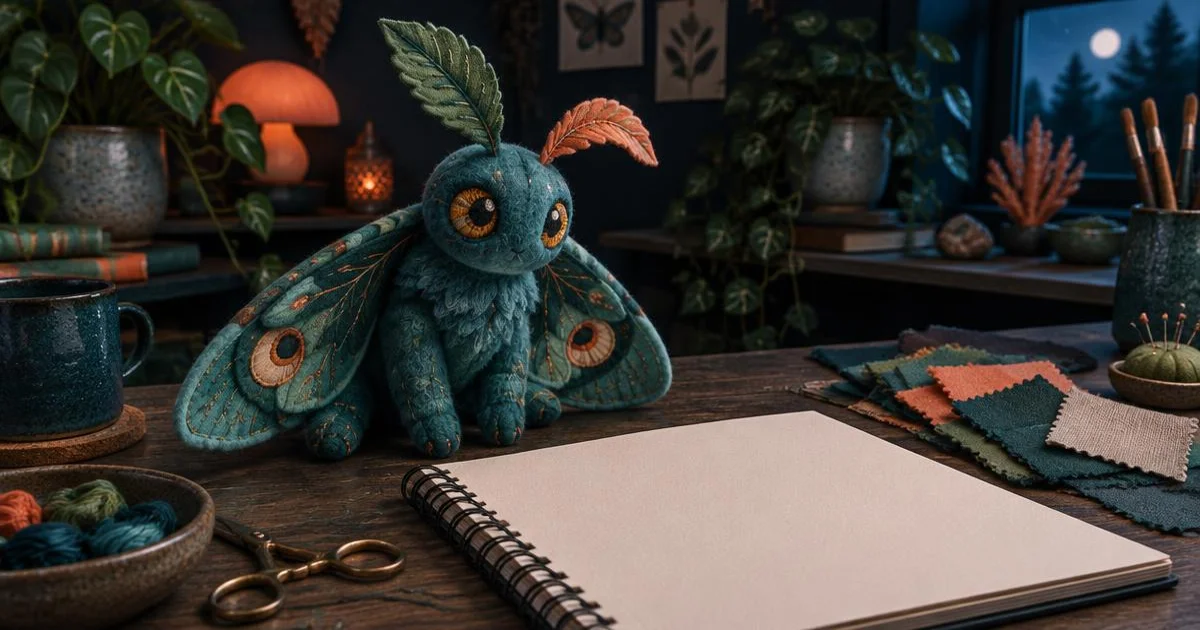
Consider an original felt moth called Brindle, with uneven leaf antennae and amber embroidered eyes. Its visual identity belongs to this example, not a real creator or member. Write down three essentials: the broad wings, the stitched eyes and the shorter left antenna. A recognizable shortlist is more useful than asking the AI to preserve every thread in a complicated photograph.
Photograph the toy as a reference, not a scan
Place your own plush against a simple background with even light. Keep its full face and defining shape visible; remove shipping labels, addresses, personal photographs and other identifying objects. Avoid a distant shelf photograph containing several toys. A clean reference makes your intention easier to communicate, although it does not guarantee an identical result.
In KOORI’s character creator, use the available uploaded-picture option or describe the toy in words. State the features that matter and choose the visual direction you want. Review the result before continuing: check antenna shape, proportions and expression. Generated artwork may reinterpret materials or seams. Keep your source photograph separately rather than treating a generated portrait as an archival copy.
Give the plush a motive beyond being adorable
A custom plush AI character becomes more interesting when it has preferences. Brindle sorts fallen leaves by the sound they make, wants to assemble a quiet reading corner and mistakenly thinks bookmarks are tiny blankets. That combination creates questions and gentle disagreements. It is more playable than a description saying only sweet, loyal and always cheerful.
Choose a conversational habit as well as a goal. Perhaps Brindle answers carefully, asks about textures and admits uncertainty. Do not instruct it to feel abandoned when you leave or demand constant attention. Your toy-inspired character is fictional entertainment, not a living pet with needs. You can enjoy imaginary rituals while keeping the physical keepsake and digital story separate.
Test the voice with one small choice
Try this opening: “You found two leaves for the reading corner. One is soft but torn; the other is smooth but noisy. Which should become the roof?” Ask for friendly, platonic dialogue and leave your own response unwritten. A useful answer reveals a preference, gives a reason and leaves space for you to disagree.
If the reply could belong to any character, revise the habit rather than adding ten more visual details. Ask Brindle to explain its sorting rule or accept a suggestion it did not expect. When the AI invents a power or changes the design, correct that fact plainly. For a continuing story, keep a short identity note; do not rely on perfect recall between conversations.
Share the character without confusing the formats
Before sharing, review the name, description and artwork for borrowed elements or personal information. Use KOORI’s existing saving and publication flow and follow its eligibility and review requirements. A saved character is not automatically a public listing. Separate pictures and Reels have their own access requirements and displayed costs; a plush reference does not make every action free.
Explain the adaptation honestly in a caption: “An original felt-moth design reimagined as a fictional AI character.” Do not advertise a scanned digital twin, guaranteed animation or physical toy integration. If followers ask how it was made, describe your design choices, reference photograph and edits. That process can be compelling without claiming the software reproduced the object exactly.
Frequently asked questions
Can I use a plush from a famous franchise?
This tutorial is for original or explicitly authorized designs. Owning a physical toy is different from holding adaptation rights. Create a new design when you do not have permission.
Will a photograph produce an exact copy?
No. A reference can guide the artwork, but generated shapes, colors and stitching can vary. Review the result and keep the original photograph.
Does KOORI make the physical toy speak?
No. The experience described here is digital character artwork and chat. It does not add electronics, scanning hardware or speech to the physical plush.
What makes a good first conversation?
Give the creature one harmless choice linked to a habit, such as choosing a leaf roof. Ask for a short answer and leave your own actions open.
Give your original keepsake a first scene
Pick three defining features, one curious habit and a small question your plush-inspired character can ask. Start with the personality rather than a promise of perfect resemblance. Create a Character, review the artwork and see whether its first answer gives you a story worth continuing.