What an OC generator should actually produce
OC means original character: a character you invented rather than one borrowed from an existing franchise. People make OCs for fan communities, webcomics, tabletop campaigns, novels and roleplay. The useful output of a generator is not a single image. It is a set of decisions you can keep reusing.
Look for five things. A name and role that suggest a story. A want and a fear that pull against each other. A voice: how the character actually talks, not a list of adjectives. A home world with one or two rules. And a visual identity with a few anchors, such as a scarf, a scar or a lantern, that stay recognizable across pictures.
If a tool only gives you the last item, you still have to do the real character work yourself. That is fine, but it helps to know which part you are getting.
Start with a contradiction, not a costume
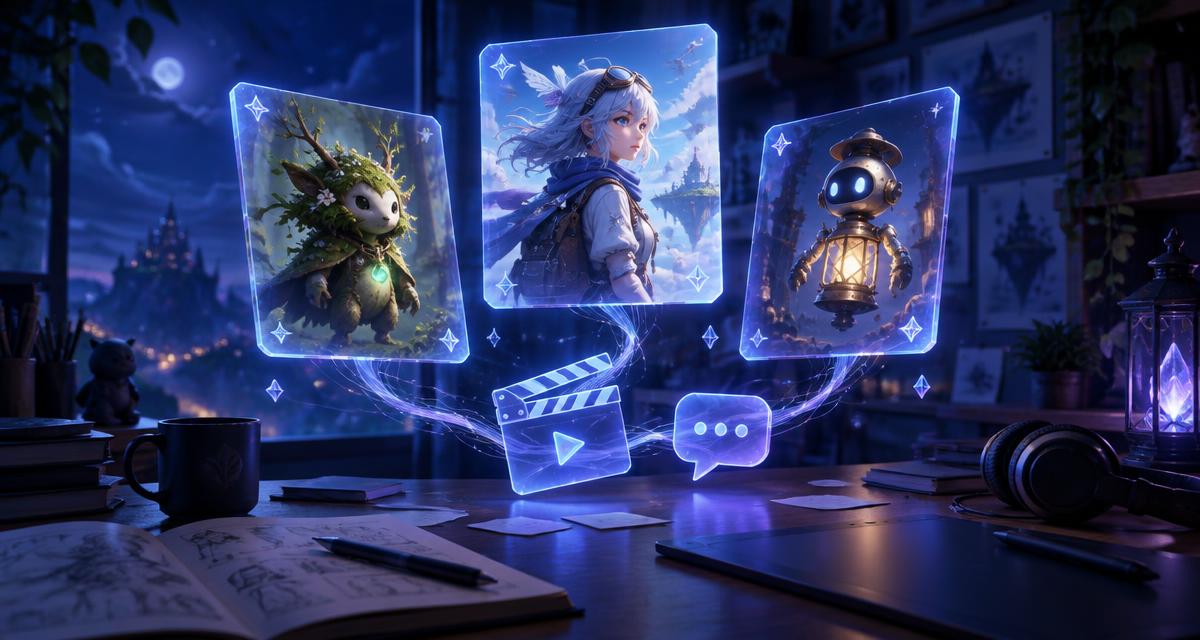
The fastest way to a memorable OC is a tension the character has to live with. A sky courier who is afraid of heights. A forest guardian who secretly wants to see the city. A lantern robot who was built to guide travelers but has forgotten the way home. Each one generates scenes on its own.
Write this in one or two sentences before you touch any style settings. If you start with the look, you tend to get a beautiful character with nothing to do. If you start with the contradiction, the look often suggests itself: the courier wears goggles pushed up because she never quite commits to flying.
Avoid copying a famous character and changing the color. Recognizable names, costumes and signature lines from existing works are not original, and they make the character harder to share or build on later.
An original sky courier named Wren who delivers letters between floating islands but is quietly afraid of heights. She is cheerful, talks fast when nervous and never admits she takes the long route on purpose.
Archetypes and genres: use them as starting points
Archetypes are useful scaffolding. The reluctant guardian, the cheerful trickster, the tired mentor, the rival with a soft spot and the creature who does not understand humans all come with built-in conversations. Pick one, then break one expectation. A mentor who is younger than you. A trickster who is terrible at lying.
Genre shapes how the character talks and what problems feel natural. A cozy fantasy OC worries about a leaking roof and a festival. A sci-fi OC worries about a failing signal and a crew decision. An anime-style rival speaks in short declarations. A monster friend asks literal questions about ordinary things. Choose the genre that matches the kind of conversation you want to have, not only the art you like.
- Monster friends:
- Literal, curious creatures who misunderstand everyday life. Great for warm, funny chats.
- Fantasy:
- Guardians, couriers, apprentices and exiled royalty with a small quest you can help with.
- Sci-fi:
- Pilots, engineers and AIs facing one decision at a time aboard a ship or station.
- Anime:
- Rivals, transfer students and reluctant heroes with strong, quotable voices.
Tutorial: make your OC in KOORI
The following steps use the character creator available after sign-in and onboarding. Generated details are suggestions. Read them, change what does not fit and treat only what you approve as canon.
From idea to a character you can talk to
- Step 1: Describe the idea. Paste your contradiction sentence. Add the role, the world and one habit. Keep it short; you can refine later.
- Step 2: Choose an art style. Pick the style that fits the genre, such as 3D, anime or illustrated. Check the face and your identity anchors in the reveal before moving on.
- Step 3: Review personality and world. Edit the generated voice, backstory and setting. Remove anything generic. Add one thing the character refuses to do.
- Step 4: Write an open first message. Let the character ask you something specific. Do not script your own reply or feelings.
- Step 5: Test the voice before saving. Try Companion mode for direct dialogue and Adventure mode for a narrated scene. Disagree with the character once and see whether it stays itself.
- Step 6: Save and keep a short canon note. Write down the three facts that must never change. Repeat an important detail in chat before it matters to a decision.
Memory: what stays and what you should keep yourself
Characters feel real when they remember. KOORI saves your chat history and stores selected facts and summaries, then retrieves relevant memories to help with continuity. That helps, but it is not perfect recall. Long stories can still lose a detail.
Keep your own source of truth: the character bible, a list of events that happened and any promises made. When something important comes up again, mention it briefly. A character that says it remembers everything is not proof; ask what was actually promised and check.
From chat to film: turning a moment into a Reel
Once a conversation produces a scene you love, you can turn it into a short video. Pick a moment that shows the contradiction: Wren gripping a railing while insisting she is fine. A Reel works best with one clear situation, a few distinct shots and an ending beat.
Choose a format that fits the moment, such as a trailer, a short scene or a slice of life. Review the plan and any credit requirement before filming. Your OC and the other characters you pick stay in the cast, so the film looks like the same world you have been chatting in. Reels are optional; a great chapter can stay as text.
Growing your OC into a world others can join
An OC becomes a fandom when other people can find a way in. Give the world a place, a recurring object and a few side characters. Decide what is fixed canon and what others may invent. Share finished characters if you want to; private characters stay yours and you can still chat and film with them.
Do not publish private conversations or other people’s messages. Use fictional details instead of real addresses or personal information. A small, consistent world that people can return to is worth more than a large cast nobody remembers.
AI OC generator FAQ
Is an AI-generated OC really mine?
Your own writing, edits and creative decisions are your contribution. Purely AI-generated material may not qualify for copyright in some places. Keep your drafts and read the platform terms before commercial use.
Can my OC look consistent across pictures?
Clear identity anchors and a saved portrait help, but no tool guarantees exact consistency. Review each new picture and keep the details that matter.
Can I keep my OC private?
Yes. You can keep a character private and still chat with it and use it in Reels. Public Discover listing is a separate, reviewed step.
Does my OC remember past chats?
Chat history and selected memories help continuity, but recall can be incomplete. Keep your own short canon note for the details that matter most.
Do I need to make videos?
No. Chat is the core experience. Pictures and Reels are optional creative branches you can use when a moment deserves it.
Sources and further reading
This guide offers creative suggestions, not legal advice. Features, credit costs and eligibility can change; check the current app before relying on a specific step. KOORI memory helps continuity but recall can be incomplete.
More from KOORI Journal