Build a campaign question instead of a lore encyclopedia
Use one original problem: a hillside town’s rain bell is silent, and the next planting season depends on repairing it. Your companion is an adult cartographer who knows the routes but distrusts the observatory keeper. The question is how to restore the bell without breaking a promise. A map, a motive and a deadline are enough.
Choose two or three rules with clear consequences. The bell needs a crystal tuned under open sky. The canal closes at dusk. The orchard keeper trades materials only for useful labor. Rules should constrain the adventure rather than explain centuries of history. Write them in a short note you can reuse when the AI drifts.
Make branches differ in cost, information and relationships
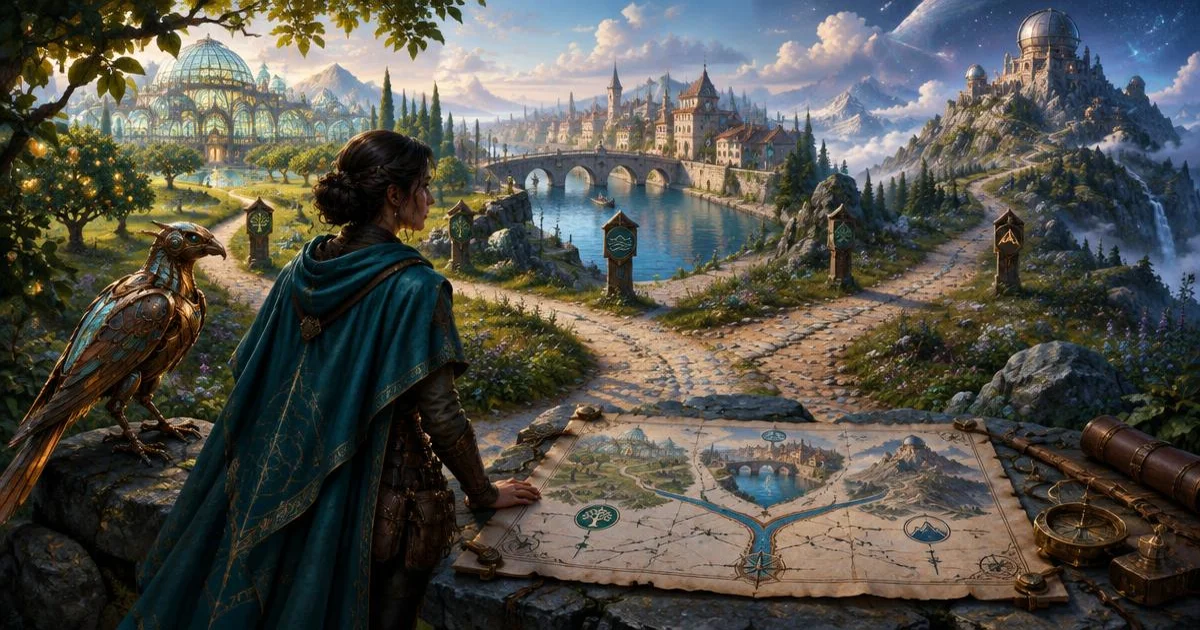
Offer three routes. Through the glass orchard, you can earn the crystal by repairing irrigation, but arrive later. Along the canal, you travel quickly, but owe a ferryman a return favor. At the observatory, you learn why the bell failed, but must negotiate with someone your companion mistrusts. Each route should offer something and leave something unresolved.
Do not call one choice correct and the others mistakes. A branching fantasy roleplay scenario is richer when different priorities produce different outcomes. Ask the AI for what becomes available after your choice, not a fixed menu followed by the same scene. If every route immediately delivers the crystal, revise the tradeoffs and state which consequence should remain.
Use a three-session adventure structure
Session one establishes the problem and route decision. Session two follows the cost of that route and reveals one complication. Session three resolves the bell problem and shows how the town responds. This small campaign structure gives you a destination without scripting every reply. Keep optional discoveries separate from the central objective.
For the orchard branch, the complication might be a cracked water channel whose repair uses the last suitable crystal. You can repair it, propose another material or ask the keeper to join the bell project. A non-graphic obstacle creates meaningful agency without relying on constant combat. Let the companion have an opinion, but do not let it choose for you.
Try: “We are fictional adult travelers trying to restore the rain bell. I chose the orchard route. Keep the canal favor unclaimed and the observatory mystery unresolved. Show one consequence of arriving late, then offer a question I can answer. Use gentle adventure, no graphic violence, and leave my actions to me.”
Track consequences in a compact campaign ledger
Keep four lines: current location, resources, promises and unresolved facts. For example: orchard workshop; one cracked crystal; promised to repair irrigation; bell failure still unexplained. Update only what changed. This is a personal writing aid, not an assertion that KOORI automatically stores every campaign variable or runs rules behind the conversation.
When returning, supply the relevant ledger and request one next action. If the AI grants an item you did not obtain, correct the inventory. If it resolves a mystery prematurely, restate what remains unknown. Saved chat history does not guarantee flawless recall. For dice or tabletop mechanics, use your own agreed rules and rolls rather than assuming a generated outcome is verifiable randomness.
Design endings that show the chosen route mattered
An orchard ending might restore both the bell and the irrigation partnership. A canal ending might succeed faster but leave a favor for a later story. An observatory ending might repair the bell after revealing that an old calibration rule was wrong. These outcomes can all succeed while preserving different relationships and unfinished possibilities.
After the final scene, summarize what changed and stop at a natural pause. Do not expand the campaign merely because the AI introduces another emergency. If you want another chapter, begin with a consequence already established. A picture or Reel can illustrate one favorite moment, but those are separate creative actions with their own requirements, not automatic campaign rewards.
Frequently asked questions
Is this different from a basic AI roleplay guide?
Yes. This guide focuses on branching routes, tradeoffs, campaign structure and consequence tracking. A basic guide explains how to choose a character and begin a conversation.
Will the world remember every choice automatically?
Do not assume that. AI may lose or confuse context. Keep a compact ledger and provide the relevant facts when continuing the adventure.
Do fantasy adventures need combat?
No. Negotiation, navigation, repairs and mysteries can supply strong choices. State a non-graphic tone and design obstacles with several reasonable solutions.
Can this replace a tabletop game engine?
This workflow is conversational fiction, not a guaranteed rules engine. Track mechanics yourself if needed, and do not assume independent party state or verified dice randomness.
Choose the first route into your world
Write one goal, three routes and a different cost for each. Start an Adventure with a character who has a reason to care, then make a choice and record its consequence. A world begins to feel responsive when your next question depends on what you already did.